
Opening Hours
Monday to Wednesday
9:00 am – 6:00 pm
Thursday
Closed
Friday
8.00 am - 5.00 pm
Saturday
8:00 am – 2:00 pm
Dental Implants
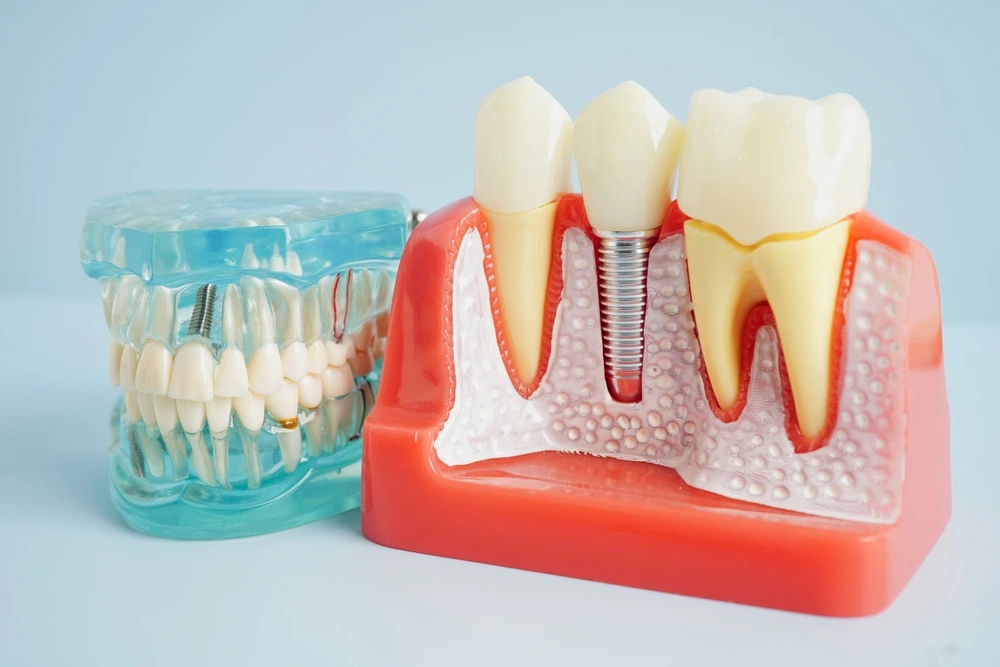
Losing a tooth can affect much more than your smile. A missing tooth can make chewing uncomfortable, change the way you speak, and allow neighboring teeth to shift over time.
Dental implants replace missing teeth with a restoration supported by an implant post.
At Add Smiles Dentistry, we provide dental implant care in Norwalk, CA, for patients looking for a stable tooth replacement option. Our team evaluates your oral health, discusses your goals, and helps determine whether dental implants are appropriate for you.
Every implant case is different, so the first step is always a detailed evaluation, not choosing treatment based on the number of missing teeth alone.
What Is a Dental Implant?
A dental implant is a small post placed in the jawbone to replace the root of a missing tooth.
After the implant has had time to integrate with the surrounding bone, it can support a dental restoration such as a crown. Depending on the situation, implants can also be used to support bridges or dentures.
A completed implant restoration is designed to look and function as part of your smile.
Why Do People Choose Dental Implants?
A missing tooth can create everyday frustrations. You may avoid certain foods, feel uncomfortable smiling, or become more conscious about the gap in your teeth.
Dental implants can provide several potential benefits:
- Replace a missing tooth without a removable appliance
- Provide a stable foundation for a dental crown
- Restore chewing function
- Support a natural-looking smile
- Help maintain the structure of the jawbone
- Avoid relying on neighboring teeth for support in certain cases
Your dentist can explain which benefits apply to your situation.
Am I a Candidate for Dental Implants?
Dental implants are not automatically appropriate for everyone. Several factors need to be considered before treatment.
Your dentist may evaluate:
- The condition of your gums
- The health of your remaining teeth
- The amount and quality of available jawbone
- Your overall oral health
- Your medical history
- Your ability to maintain good oral hygiene
- Whether you have enough space for the planned restoration
If there is not enough bone to support an implant, additional treatment such as bone grafting may sometimes be considered.
Candidacy is determined individually. A consultation gives you a clearer understanding of what is possible in your case.
What Does the Dental Implant Process Involve?
Dental implant treatment usually takes place in stages.
Step 1: Evaluation and Treatment Planning
Your dentist will first examine your mouth and assess the area where the tooth is missing. Imaging may be recommended to evaluate the bone and surrounding structures.
This is also when you can discuss your concerns, expectations, timeline, and replacement options.
Step 2: Implant Placement
The implant post is placed into the jawbone during surgery. The exact approach depends on the missing tooth's location and your individual anatomy.
Step 3: Healing and Integration
The implant needs time to integrate with the surrounding bone. This process is important because it creates the foundation needed to support the final restoration.
The healing period varies from patient to patient.
Step 4: Final Restoration
Once healing is complete and the implant is ready, the final restoration can be placed.
For a single missing tooth, this may be a dental crown designed to blend with your surrounding teeth.
Will Getting a Dental Implant Hurt?
It is understandable to feel nervous about implant surgery.
The procedure is performed using appropriate anesthesia to keep you comfortable during treatment. Afterward, you may experience some soreness, swelling, or sensitivity as your mouth heals.
Your dental team will give you care instructions for the surgical area and explain what to expect during recovery.
If you have dental anxiety, tell your team before treatment. Knowing what will happen and having your questions answered can make the experience much easier.
How Long Does Dental Implant Treatment Take?
No single timeline applies to every patient.
Some cases are relatively straightforward, while others require additional procedures or longer healing periods. The number of missing teeth, bone condition, gum health, and type of restoration can all affect treatment time.
During your consultation, you can ask for an estimated timeline based on your specific case.
What If I Have Bone Loss?
Bone loss does not automatically mean that dental implants are impossible.
When a tooth has been missing for a long time, the surrounding jawbone may gradually decrease in volume. In some situations, bone grafting may be recommended before or as part of implant treatment.
The need for grafting can only be determined after your dentist evaluates the implant site.
Can Dental Implants Replace Multiple Missing Teeth?
Yes. Dental implants can be used in several different ways depending on how many teeth are missing.
A single implant may support a crown for one missing tooth. Multiple implants may support an implant-supported bridge or another type of restoration when several teeth are missing.
For patients with extensive tooth loss, implant-supported dentures may also be an option.
The right approach depends on your oral health, anatomy, goals, and budget.
How Do You Care for Dental Implants?
Dental implants still require regular care.
Although the replacement tooth itself cannot develop a cavity in the same way as a natural tooth, the gums and tissues surrounding the implant can still develop problems if oral hygiene is neglected.
Continue to:
- Brush twice a day
- Clean between your teeth and around the implant
- Attend regular dental appointments
- Follow your dentist's cleaning recommendations
- Report bleeding, swelling, discomfort, or changes around the implant
Long-term maintenance is an important part of protecting your investment.
Dental Implants vs. Dentures and Bridges
No single tooth replacement solution is right for everyone.
Dentures can replace several or all missing teeth and can be removed for cleaning. Bridges can replace one or more missing teeth by using neighboring teeth or implants for support.
Implants offer a different approach by using an implant post within the jawbone.
During your consultation, your dentist can explain the advantages and limitations of each option so you can decide based on your needs.
Why Choose Add Smiles Dentistry for Dental Implants?
Add Smiles Dentistry provides restorative dental care in a modern Norwalk environment, with treatment planning focused on the individual patient. The practice offers dental implants as part of its restorative and oral surgery services.
Dr. Aditi Pampaniya has also completed dental implant training and a reconstructive program through the Global Dental Implant Academy.
Replace a Missing Tooth With a Plan That Fits You
If you are considering dental implants in Norwalk, CA, the best place to start is a consultation.
At Add Smiles Dentistry, we can evaluate your smile, discuss your options, and help you understand what the implant process may look like for your specific situation.
Contact Us
Our team is happy to hear from you! Fill out our simple form to schedule your next visit.
Email us at info@addsmiles.com
Call us at (562) 204-6366
Schedule Your Visit!
*Name
*Phone Number
*Message
Our dental practice is designed to provide state-of-the-art care with the latest technology and a wide range of dental services with transparent pricing.
14523 Pioneer Blvd, Norwalk, CA 90650, USA


© 2025 Add Smiles Dentistry | All rights reserved | Privacy Policy | Digital Marketing by Remedo